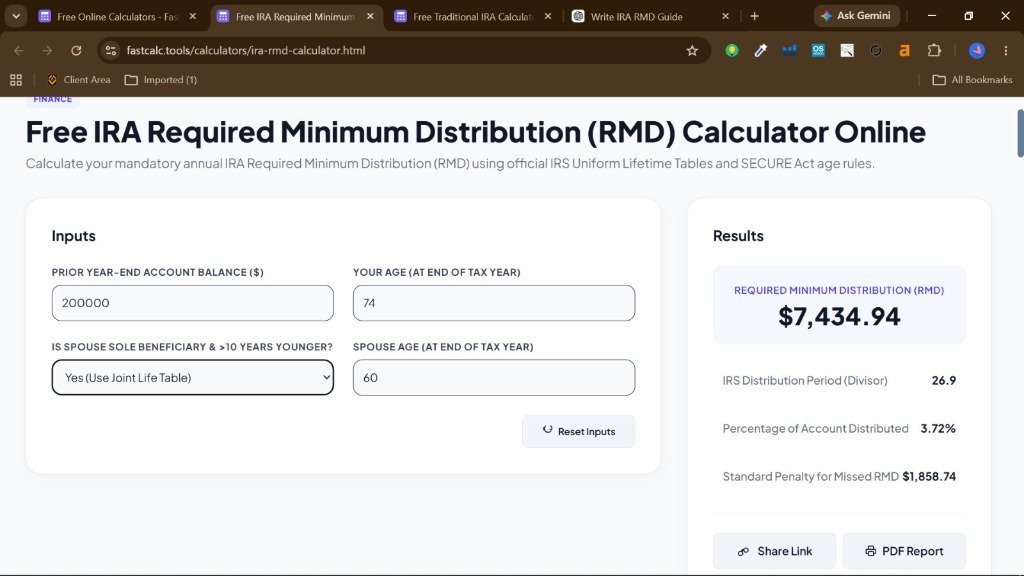
Free IRA Required Minimum Distribution (RMD) Calculator Online
Calculate your mandatory annual IRA Required Minimum Distribution (RMD) using official IRS Uniform Lifetime Tables and SECURE Act age rules.
Inputs
Results
Related Calculators
IRA Required Minimum Distribution: A Complete Guide
An IRA Required Minimum Distribution (RMD) is the minimum amount that certain retirement account owners must withdraw from their retirement savings each year after reaching a specific age. Understanding RMD rules is important because taking too little or missing a required withdrawal can result in significant tax consequences.
RMD rules can apply to traditional retirement accounts, including traditional IRAs, SEP IRAs, and SIMPLE IRAs. They generally do not apply to Roth IRAs while the original owner is alive. However, inherited retirement accounts have their own distribution rules.
This guide explains how IRA Required Minimum Distributions work, when withdrawals must begin, how RMDs are calculated, what happens if you miss one, and how taxes can affect your retirement income.
What Is an IRA Required Minimum Distribution?
An IRA Required Minimum Distribution is the minimum amount that an account owner is generally required to withdraw from an applicable retirement account each year after reaching the applicable RMD age.
IRAs are designed to help people save for retirement while receiving certain tax advantages. Contributions to some IRAs may receive tax benefits, and investment earnings can grow tax-deferred. Because taxes may have been deferred for many years, the government eventually requires distributions from most traditional retirement accounts.
The RMD is calculated based primarily on your retirement account balance and a life-expectancy factor published by the IRS.
The amount you must withdraw is not necessarily the amount you need to spend. You can withdraw the required amount and use it for living expenses, investment purposes outside the IRA, gifts, or other financial needs.
When Do IRA Required Minimum Distributions Begin?
The age at which RMDs begin has changed over time because of federal retirement legislation.
Under current rules, the applicable starting age depends on your birth year. For many current retirees, the RMD starting age is 73. The rules can differ for people born in different years, so it is important to check the rules that apply to your specific situation.
Your first RMD generally has a special deadline. Although RMDs for later years generally must be taken by December 31 of the applicable year, the first RMD may generally be delayed until April 1 of the following year.
However, delaying your first RMD can result in two RMDs being required in the following calendar year: the delayed first distribution and the distribution for that second year.
For this reason, delaying the first RMD should be considered carefully.
Which Retirement Accounts Have RMDs?
RMD requirements generally apply to several types of tax-deferred retirement accounts.
These can include:
- Traditional IRAs
- SEP IRAs
- SIMPLE IRAs
- Most employer-sponsored retirement plans
- Certain other tax-deferred retirement arrangements
RMD rules for employer plans can differ from IRA rules.
For example, workplace retirement plans may have special provisions concerning employees who are still working. IRA rules generally do not provide the same type of "still working" exception.
Roth IRAs are treated differently. Under current rules, the original owner of a Roth IRA does not generally have to take RMDs during their lifetime.
Inherited Roth IRAs and inherited traditional IRAs can be subject to distribution requirements.
How Is an IRA RMD Calculated?
Your annual RMD is generally calculated using a formula:
RMD = Previous Year-End Account Balance ÷ Applicable Life Expectancy Factor
The previous year-end balance is generally the value of the retirement account on December 31 of the previous year.
The life-expectancy factor comes from an IRS life-expectancy table.
For many account owners, the Uniform Lifetime Table is used. However, different tables may apply in certain circumstances.
For example, if your spouse is more than 10 years younger than you and is your sole beneficiary, a different IRS table may be used to calculate the RMD.
Example of an RMD Calculation
Suppose your IRA had a balance of $500,000 on December 31 of the previous year.
Assume the applicable IRS life-expectancy factor is 25.5.
The calculation would be:
$500,000 ÷ 25.5 = $19,607.84
Your approximate RMD would therefore be $19,608 for that year.
The actual calculation depends on your age, account balance, beneficiary circumstances, and the IRS table applicable to you.
Why Your Previous Year-End Balance Matters
One important part of the RMD calculation is that the account balance generally comes from the end of the previous calendar year.
For example, an RMD for 2027 would generally be calculated using the applicable IRA balance as of December 31, 2026.
This means market performance during the current year generally does not change the amount of that year's RMD after the calculation has been established.
However, the value of your account at the end of the current year can affect the RMD required for the following year.
Because investment values fluctuate, the RMD amount can change from year to year.
Can You Take More Than the Required Minimum?
Yes. An RMD is a minimum distribution, not a maximum.
If your calculated RMD is $20,000, you can generally withdraw more than $20,000.
For example, you might decide to withdraw $30,000 to cover living expenses or other financial needs.
However, taking more than the required amount does not generally allow the excess to count toward the next year's RMD.
Each year's RMD generally needs to be satisfied separately.
Taking substantially more than required may also increase taxable income and potentially affect other areas of your finances.
Are IRA Required Minimum Distributions Taxable?
For a traditional IRA, RMDs are generally included in taxable income to the extent that the distribution represents taxable amounts.
If you made nondeductible contributions to a traditional IRA, part of a distribution may potentially be nontaxable depending on your basis and applicable tax rules.
The taxable amount can affect your overall federal income tax liability.
For example, if you receive $25,000 of taxable IRA distributions during a year, that amount may be included in your taxable income along with income from other sources.
Your actual tax liability depends on your complete tax situation.
RMDs and Federal Income Tax
Because RMDs can increase taxable income, retirement planning should consider the interaction between IRA withdrawals and other sources of income.
Retirement income may come from:
- IRA distributions
- 401(k) withdrawals
- Social Security benefits
- Pension income
- Investment income
- Interest
- Dividends
- Business income
A larger RMD can increase your total income for the year.
This can potentially affect your federal income tax bracket and other income-related calculations.
For this reason, it may be useful to estimate future RMDs before retirement or before reaching the applicable RMD age.
What Happens If You Miss an RMD?
Missing an RMD can result in an excise tax.
Federal law has changed the penalty structure for missed RMDs. The excise tax can generally be reduced when the missed amount is corrected within the applicable correction period and certain requirements are met.
The penalty can still be significant, so missing an RMD should be taken seriously.
If you discover that you failed to take the required distribution, consider taking the missed distribution as soon as possible and consulting a qualified tax professional about the appropriate reporting and correction procedures.
Do not assume that simply withdrawing the missed amount automatically resolves every tax requirement.
Can You Take an RMD in Multiple Withdrawals?
Generally, you do not necessarily have to take your annual RMD as one single withdrawal.
For example, if your annual RMD is $24,000, you could potentially take:
- $2,000 per month for 12 months
- $6,000 every quarter
- Several larger withdrawals during the year
- One annual distribution
The important consideration is that the required amount is distributed within the applicable deadline.
Your IRA provider may offer different distribution schedules, so check with your financial institution before setting up automatic withdrawals.
What Is a Qualified Charitable Distribution?
A Qualified Charitable Distribution (QCD) allows eligible IRA owners to transfer money directly from an IRA to a qualifying charity, subject to applicable rules and annual limits.
QCDs can be useful for some retirees who want to donate to charity while also dealing with IRA distribution requirements.
A properly structured QCD can potentially satisfy an RMD while offering different tax treatment than receiving the distribution personally and then making a charitable contribution.
However, QCD rules include eligibility requirements and annual limits. The distribution generally needs to be made directly from the IRA to the eligible charitable organization.
If you are considering a QCD, verify the current rules and documentation requirements with your IRA provider or tax professional.
RMDs From Multiple IRAs
If you own multiple traditional IRAs, calculating your RMDs requires attention to each account.
Generally, the RMD is calculated separately for each IRA. However, IRA owners may generally aggregate the RMD amounts from their traditional IRAs and take the total required amount from one or more of those IRAs.
This rule can provide flexibility in deciding which account to use for the distribution.
Different rules can apply to employer retirement plans, so retirement accounts should not automatically be treated the same way.
RMDs for Inherited IRAs
Inherited IRAs have special rules.
If you inherit an IRA from someone else, the distribution requirements can depend on several factors, including:
- When the original owner died
- The age of the original owner
- Your relationship to the original owner
- Whether you are an eligible designated beneficiary
- Whether the account is traditional or Roth
- The applicable federal rules
The rules for inherited retirement accounts have changed significantly in recent years.
Beneficiaries should therefore avoid relying on old RMD information when managing an inherited IRA.
RMD Planning Strategies
Planning ahead can make required distributions easier to manage.
1. Estimate Future RMDs
Review your retirement account balance and estimate how future RMDs could affect your income.
2. Review Beneficiary Designations
Make sure beneficiary information on your retirement accounts is current and accurately reflects your estate-planning intentions.
3. Consider Your Tax Bracket
Large distributions can increase taxable income. Consider how withdrawals interact with your other income.
4. Consider Charitable Giving
If charitable donations are part of your financial plan, investigate whether QCDs may be appropriate.
5. Avoid Last-Minute Withdrawals
Waiting until the end of the year can create unnecessary administrative pressure. Establishing a distribution schedule earlier may make RMD management easier.
IRA RMD Calculator
An IRA RMD Calculator can help estimate how much you may need to withdraw from your retirement account.
A typical calculator may require:
- Current age
- IRA balance
- Birth year
- Spouse's age
- Beneficiary information
- Account type
- Applicable life-expectancy factor
The calculator can provide an estimate based on the information entered.
However, an online calculator should generally be considered an educational planning tool rather than a substitute for official IRS guidance or professional tax advice.
Common IRA RMD Mistakes
Several mistakes can create unnecessary tax problems.
Forgetting the RMD Deadline
Missing the applicable deadline can result in an excise tax.
Using the Wrong Account Balance
The RMD calculation generally uses the previous year's December 31 balance.
Using the Wrong IRS Table
Different circumstances can require different life-expectancy tables.
Assuming Roth IRAs Have the Same Rules
Original owners of Roth IRAs generally do not have lifetime RMDs, unlike traditional IRAs.
Taking Too Little
The distribution must satisfy the applicable annual requirement.
Assuming Excess Withdrawals Carry Forward
Taking more than your required amount generally does not eliminate the following year's RMD.
How to Prepare for Your RMD
A simple annual process can help you stay organized.
First, identify all retirement accounts subject to RMD rules. Next, determine the previous December 31 balance for each account.
Then identify the applicable IRS life-expectancy factor and calculate the required amount.
After determining the RMD, contact your IRA provider to establish the distribution. Keep records of the amount withdrawn and the date of the distribution.
Finally, review your tax documents after the end of the year and keep supporting records for your tax return.
Final Thoughts
An IRA Required Minimum Distribution is an important part of retirement planning for owners of many tax-deferred retirement accounts. Understanding when RMDs begin, how the amount is calculated, how withdrawals are taxed, and what happens if you miss a deadline can help you manage retirement savings more effectively.
RMD rules can be complex, especially when you have multiple accounts, an inherited IRA, a younger spouse, nondeductible contributions, or charitable-giving plans.
Because federal retirement rules can change, always verify the rules applicable to the specific tax year and your personal circumstances. For significant retirement or tax decisions, consider consulting a qualified financial or tax professional.
FAQs About IRA Required Minimum Distribution
1. What is an IRA Required Minimum Distribution?
An IRA Required Minimum Distribution is the minimum amount that an eligible retirement account owner generally must withdraw each year after reaching the applicable RMD age.
2. At what age do IRA RMDs start?
The applicable starting age depends on your birth year and current federal law. For many current retirees, the starting age is 73.
3. Are Roth IRA owners required to take RMDs?
Under current rules, the original owner of a Roth IRA generally does not have to take RMDs during their lifetime. Inherited Roth IRAs can have different rules.