Free Roth vs Traditional IRA Calculator Online
Compare Roth vs Traditional IRA options side-by-side, analyzing current tax savings against future tax-free growth.
Inputs
Results
Related Calculators
Roth vs Traditional IRA Calculator: Compare Retirement Savings and Taxes
Planning for retirement often involves choosing the right type of Individual Retirement Account (IRA). Two of the most common options are a Roth IRA and a Traditional IRA. Although both accounts are designed to help people save for retirement, they have important differences in how contributions and withdrawals are taxed.
A Roth vs Traditional IRA Calculator helps you compare these two retirement savings options using factors such as income, contribution amount, current tax rate, expected retirement tax rate, investment return, years until retirement, and expected withdrawals.
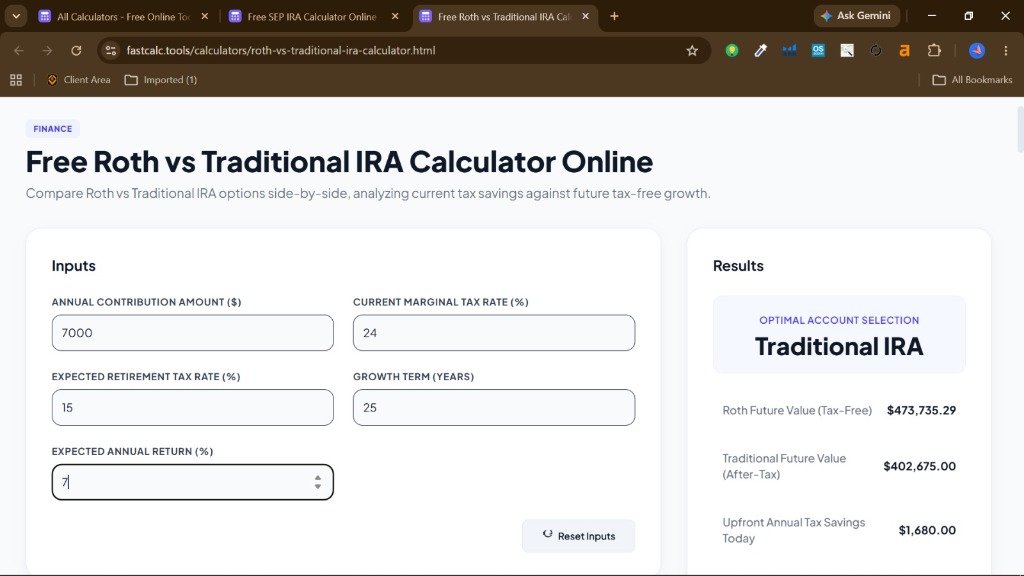
Instead of looking only at the amount contributed today, a calculator can help illustrate how taxes may affect the amount available for retirement. The results are estimates based on the assumptions entered and should be used as a planning tool rather than a guarantee of future investment or tax results.
What Is a Roth vs Traditional IRA Calculator?
A Roth vs Traditional IRA Calculator is an online financial tool that compares the potential long-term results of contributing to a Roth IRA versus a Traditional IRA.
The calculator typically considers:
- Current age
- Retirement age
- Annual contribution
- Current income
- Current tax rate
- Expected retirement tax rate
- Expected annual investment return
- Number of years until retirement
- Current retirement savings
- Expected inflation
- Contribution frequency
- Tax treatment of withdrawals
The calculator can then estimate the potential future value of each account and show how taxation may affect the amount available after retirement.
This can make it easier to understand the difference between paying taxes before investing and potentially paying taxes later.
What Is a Traditional IRA?
A Traditional IRA is a retirement account that may allow eligible taxpayers to make deductible contributions, depending on their circumstances.
With a Traditional IRA, contributions may provide a tax deduction if the taxpayer qualifies. Investments can generally grow tax-deferred inside the account. Taxes are generally owed when money is withdrawn.
Whether a contribution is deductible can depend on factors such as income, filing status, and whether the taxpayer or spouse is covered by a retirement plan at work.
Traditional IRA withdrawals are generally included in taxable income, although the exact tax treatment depends on the nature of the distribution and the individual's circumstances.
What Is a Roth IRA?
A Roth IRA is a retirement account with a different tax structure.
Contributions to a Roth IRA are generally made with after-tax money, meaning contributions are not deductible. Qualified distributions can generally be withdrawn tax-free.
Roth IRAs also have income eligibility rules. Not everyone can make a direct Roth IRA contribution at every income level, although other rules and strategies may apply depending on the taxpayer's circumstances.
Because taxes are generally paid before money enters the Roth IRA, the account can provide tax-free qualified withdrawals later.
Roth IRA vs Traditional IRA: Key Difference
The primary difference between the two accounts is when taxes are paid.
A simplified comparison looks like this:
| Feature | Traditional IRA | Roth IRA |
|---|---|---|
| Contributions | May be deductible if eligible | Generally not deductible |
| Investment growth | Generally tax-deferred | Generally tax-free if requirements are met |
| Qualified retirement withdrawals | Generally taxable | Generally tax-free |
| Income restrictions | Deduction rules may apply | Direct contribution income limits apply |
| Tax timing | Potential tax benefit today | Potential tax benefit later |
| RMD considerations | Generally subject to RMD rules | Original owner generally has no lifetime RMD requirement |
The actual tax result depends on the individual's circumstances and the tax rules applicable to the year of contribution and withdrawal.
How Does a Roth vs Traditional IRA Calculator Work?
A calculator starts by asking for financial assumptions.
For example, suppose you plan to contribute $7,000 per year for 30 years and assume a particular annual investment return.
The calculator can estimate how those contributions might grow over the 30-year period.
It then applies the relevant tax assumptions to illustrate the potential difference between:
Traditional IRA: potential tax deduction now + taxable withdrawals later
and
Roth IRA: after-tax contribution now + potentially tax-free qualified withdrawals later
This comparison is particularly useful because the account with the larger balance does not necessarily provide the larger after-tax retirement value.
Taxes can significantly affect the amount that can ultimately be spent.
Important Inputs in a Roth vs Traditional IRA Calculator
Current Annual Income
Your income can affect whether Traditional IRA contributions are deductible and whether you are eligible to contribute directly to a Roth IRA.
Annual IRA Contribution
Enter the amount you plan to contribute each year.
The annual IRA contribution limit can change over time, so a calculator should use the applicable limit for the tax year being analyzed.
Current Tax Rate
The current tax rate is important when estimating the potential immediate tax benefit associated with a deductible Traditional IRA contribution.
Expected Retirement Tax Rate
Your future tax rate can be difficult to predict, but it is an important assumption.
For example, someone who expects a lower tax rate during retirement may place greater value on potential deductions today, while someone expecting a similar or higher tax rate may place more importance on tax-free qualified Roth withdrawals.
Current Age
Your current age determines how many years remain before retirement.
Retirement Age
Your expected retirement age helps determine the investment period.
For example, a person age 30 planning to retire at 65 has approximately 35 years for contributions and potential investment growth.
Expected Investment Return
The calculator may use an assumed annual rate of return to project future account values.
Investment returns are not guaranteed. Actual returns can vary considerably over time.
Inflation Rate
Inflation can reduce the future purchasing power of money.
Some calculators provide results in future dollars, while others may also show inflation-adjusted values.
Why Tax Rate Matters
Tax rate is one of the most important variables in a Roth vs Traditional IRA comparison.
Consider a simplified example.
Suppose you have money available for retirement saving and are currently paying taxes at a relatively high marginal rate. A deductible Traditional IRA contribution could potentially reduce taxable income if you meet the applicable requirements.
With a Roth IRA, you generally pay tax before making the contribution. In exchange, qualified withdrawals can generally be tax-free.
The important question is not simply:
"Which account has a higher balance?"
Instead, the comparison should consider:
"How much money could I potentially have available after taxes?"
This is why an IRA comparison calculator can be useful.
Traditional IRA Tax Deduction
A Traditional IRA contribution may be fully deductible, partially deductible, or nondeductible depending on the taxpayer's circumstances.
Deductibility can depend on income, filing status, and participation in an employer-sponsored retirement plan.
For this reason, a calculator should not automatically assume that every Traditional IRA contribution receives a tax deduction.
If the contribution is deductible, the potential tax savings can be estimated using the applicable marginal tax rate.
For example, if a hypothetical $5,000 contribution were fully deductible and the applicable marginal tax rate were 22%, the simplified potential federal tax reduction would be:
$5,000 × 22% = $1,100
This is only an illustration. Actual tax savings can differ based on the taxpayer's complete tax situation.
Roth IRA Tax Advantages
The primary tax feature of a Roth IRA is the potential for tax-free qualified distributions.
Instead of receiving a potential deduction when contributing, the taxpayer generally pays taxes before making the contribution.
If the Roth IRA meets the applicable requirements, qualified withdrawals can generally be made without federal income tax.
This can make Roth IRAs useful for people who want to build retirement assets that may provide tax-free qualified income later.
Roth vs Traditional IRA Growth
Both account types can potentially hold investments that grow over time.
The difference is primarily the tax treatment.
Consider a hypothetical investment that grows from $50,000 to $150,000.
The amount of tax ultimately paid can differ depending on whether the money is held in a Traditional IRA or Roth IRA and whether the applicable distribution requirements are satisfied.
A calculator can illustrate these differences over a longer period.
Compound Growth and IRA Savings
Compound growth means that investment returns can generate additional returns over time.
A simplified future-value formula is:
FV = P × (1 + r)^n
Where:
- FV = future value
- P = starting amount
- r = annual return
- n = number of years
When regular contributions are added, the calculation becomes more complex because each contribution can have a different amount of time to grow.
For retirement accounts, a long investment horizon can make compound growth an important part of the overall projection.
Roth vs Traditional IRA for Young Investors
Younger investors often have a long period before retirement, which means taxes and compound growth can have a significant effect on long-term planning.
Someone early in their career may currently have a relatively low income and tax rate but expect their income to increase later.
A Roth IRA may be considered in such circumstances because taxes are generally paid before contributions, while qualified withdrawals can generally be tax-free.
However, individual circumstances vary, and income eligibility and contribution rules still need to be considered.
Roth vs Traditional IRA for High-Income Earners
Higher-income taxpayers need to pay particular attention to IRA rules.
Income can affect whether a Traditional IRA contribution is deductible and whether a person can make a direct Roth IRA contribution.
The applicable thresholds depend on tax year and filing status.
For this reason, an up-to-date Roth vs Traditional IRA Calculator should use current IRS limits rather than relying on outdated thresholds.
Required Minimum Distributions
Traditional IRAs are generally subject to required minimum distribution rules once the account owner reaches the applicable RMD age.
Roth IRAs do not generally require lifetime RMDs for the original owner.
This difference can be relevant to retirement planning because it can affect when money must be withdrawn from an account.
RMD rules can change, so users should verify the current requirements when making long-term plans.
Roth Conversion and IRA Planning
Some people use Roth conversions as part of their retirement strategy.
A Roth conversion generally involves moving eligible funds from a Traditional IRA or another eligible retirement account into a Roth IRA.
The converted amount may generally be included in taxable income, subject to applicable rules.
A Roth vs Traditional IRA Calculator may help illustrate why tax rates and timing matter, but a conversion analysis can require additional calculations beyond a simple IRA comparison.
Benefits of Using a Roth vs Traditional IRA Calculator
An IRA comparison calculator can provide several useful benefits.
Compare Tax Timing
It helps illustrate the difference between paying taxes today and potentially paying taxes during retirement.
Estimate Long-Term Growth
The calculator can project potential account growth over many years.
Compare Retirement Outcomes
You can compare hypothetical after-tax values under different assumptions.
Test Different Tax Rates
Changing the current or expected retirement tax rate can demonstrate how sensitive the comparison is to tax assumptions.
Plan Contributions
You can evaluate different annual contribution amounts while staying within applicable limits.
Understand Compounding
Long-term projections can demonstrate the potential impact of consistent retirement contributions and investment growth.
Limitations of a Roth vs Traditional IRA Calculator
A calculator cannot predict the future with certainty.
Tax laws may change, investment returns fluctuate, inflation varies, and personal income can change over time.
The calculator also depends on the assumptions you provide. A projection based on a 7% annual return, for example, does not mean that an investment will actually earn 7% every year.
Similarly, an assumed retirement tax rate may be significantly different from the rate that ultimately applies.
The results should therefore be viewed as estimates rather than guarantees.
How to Use a Roth vs Traditional IRA Calculator
Using the calculator is generally simple.
Step 1: Enter your current age.
Step 2: Enter your expected retirement age.
Step 3: Enter your annual IRA contribution.
Step 4: Enter your current tax rate.
Step 5: Enter your estimated retirement tax rate.
Step 6: Enter your expected annual investment return.
Step 7: Enter any existing retirement savings if supported.
Step 8: Review the estimated future value and potential after-tax value.
You can then change individual assumptions and compare different scenarios.
What Should You Consider Beyond the Calculator?
A calculator is only one part of retirement planning.
You may also want to consider:
- Employer-sponsored retirement plans
- 401(k) contributions
- Employer matching contributions
- Current and future income
- Emergency savings
- Investment risk
- Retirement spending needs
- Social Security
- Tax diversification
- Estate planning
- Required minimum distributions
- State income taxes
Considering several factors can provide a more complete picture of retirement planning.
Final Thoughts
A Roth vs Traditional IRA Calculator can help you understand the potential differences between two major retirement savings options. The key distinction is tax timing: Traditional IRAs may provide a tax deduction for eligible contributions, with generally taxable withdrawals later, while Roth IRAs generally use after-tax contributions and can provide tax-free qualified withdrawals.
Your current tax rate, expected retirement tax rate, income, age, investment horizon, contribution amount, and retirement goals can all influence the comparison.
There is no single calculation that applies equally to everyone. Instead, the calculator can help you test different assumptions and understand how those assumptions affect potential retirement outcomes.
For accurate planning, use current IRS rules and consider discussing your individual circumstances with a qualified tax or financial professional.
Frequently Asked Questions
1. What is a Roth vs Traditional IRA Calculator?
It is a financial planning tool that compares the potential growth and tax consequences of investing through a Roth IRA versus a Traditional IRA.
2. What is the main difference between a Roth IRA and Traditional IRA?
A Traditional IRA may provide a tax deduction for eligible contributions, while withdrawals are generally taxable. Roth IRA contributions are generally made with after-tax money, while qualified withdrawals can generally be tax-free.
3. Which tax rate should I enter into the calculator?
You can enter your current marginal tax rate and an estimated retirement tax rate. Because future tax rates are uncertain, consider testing several scenarios.
4. Can I contribute to both a Roth IRA and Traditional IRA?
Generally, you can contribute to both types of IRA in the same tax year, but the combined contributions are subject to the applicable annual IRA contribution limit.
5. Does income affect Roth IRA eligibility?
Yes. Income can affect eligibility for direct Roth IRA contributions. The applicable limits vary by tax year and filing status.
6. Are Traditional IRA contributions always tax deductible?
No. Deductibility depends on factors such as income, filing status, and whether you or your spouse participates in an employer-sponsored retirement plan.
7. Are Roth IRA withdrawals tax-free?
Qualified Roth IRA distributions can generally be tax-free. Whether a distribution qualifies depends on applicable IRS requirements.
8. Does a Roth IRA have required minimum distributions?
The original owner of a Roth IRA generally does not have lifetime RMDs. Different rules can apply to inherited Roth IRAs.
9. Can I change my IRA strategy later?
Retirement planning can change as your income, tax situation, and goals change. Certain transactions, such as Roth conversions, can have tax consequences and should be evaluated carefully.
10. How does compound interest affect an IRA?
Compounding allows investment returns to potentially generate additional returns over time. The longer the investment period, the more significant compounding can become.
11. Does the calculator guarantee my retirement balance?
No. Calculator results are estimates based on assumptions. Actual investment returns, taxes, inflation, contributions, and retirement circumstances can differ.
12. Should I use my current tax rate or future tax rate?
A useful comparison considers both. The current rate can affect the potential benefit of a deductible Traditional IRA contribution, while the expected future rate can affect the tax cost of Traditional IRA withdrawals.
13. Can I use the calculator for early retirement?
Yes. You can enter your desired retirement age and investment period to create a hypothetical projection. Early retirement may also involve additional tax and withdrawal considerations.
14. Can a Roth IRA provide tax diversification?
Yes. Having retirement assets with different tax treatments can provide flexibility when managing taxable income during retirement.
15. Is a Roth IRA or Traditional IRA better for everyone?
The tax and financial characteristics of each account differ, and the appropriate choice depends on factors such as income, tax situation, retirement timeline, eligibility, and financial goals. A calculator can help compare the potential outcomes under your assumptions.