Massachusetts Paycheck Calculator
Calculate your Massachusetts paycheck instantly using the latest 2026 federal and state tax rates.
Inputs
Pre-Tax Deductions
After-Tax (Post-Tax) Deductions
Bonuses & Overrides
Results Summary
Pay Period Equivalences
| Interval | Net Amount |
|---|---|
| Annual | $0.00 |
| Monthly | $0.00 |
| Semi-Monthly | $0.00 |
| Biweekly | $0.00 |
| Weekly | $0.00 |
| Daily | $0.00 |
| Hourly | $0.00 |
Federal Income Tax
Federal income tax is a progressive tax withheld from your earnings based on IRS tax brackets. Your tax rate increases as your taxable income exceeds predetermined thresholds.
State Income Tax
State income tax is levied by individual state governments. Depending on the state, it can be a flat rate, a progressive scale, or zero.
Social Security
Social Security tax is a federal payroll tax under FICA that funds the retirement and disability benefits program. It is withheld at a flat 6.20% rate up to the annual limit.
Medicare
Medicare tax is withheld at a base rate of 1.45% under FICA to fund hospital insurance benefits. High earners face an additional 0.9% surtax on wages over $200k.
Pre-Tax Deductions
Pre-tax deductions (e.g. standard 401k, HSA, FSA, health premium payments) are taken from gross wages before taxes are calculated, lowering your overall tax bill.
After-Tax Deductions
After-tax deductions (e.g. Roth 401k, life insurance, union dues, charity) occur after tax withholdings are processed and do not reduce taxable wages.
Massachusetts Paycheck Calculator: Estimate Your Take-Home Pay Accurately
Whether you're starting a new job, negotiating a salary, or planning your monthly budget, understanding how much money you'll actually take home is essential. While your gross salary tells you how much you earn before deductions, your net pay—also known as take-home pay—is what lands in your bank account after taxes and other deductions are withheld. A Massachusetts Paycheck Calculator makes this process simple by estimating your paycheck based on your income, tax withholding, and deductions.
Massachusetts has a relatively straightforward income tax system compared to many other states, but your paycheck is still affected by federal income tax, Social Security, Medicare, retirement contributions, health insurance premiums, and other payroll deductions. Using a paycheck calculator helps you estimate your earnings with greater confidence and plan your finances more effectively.
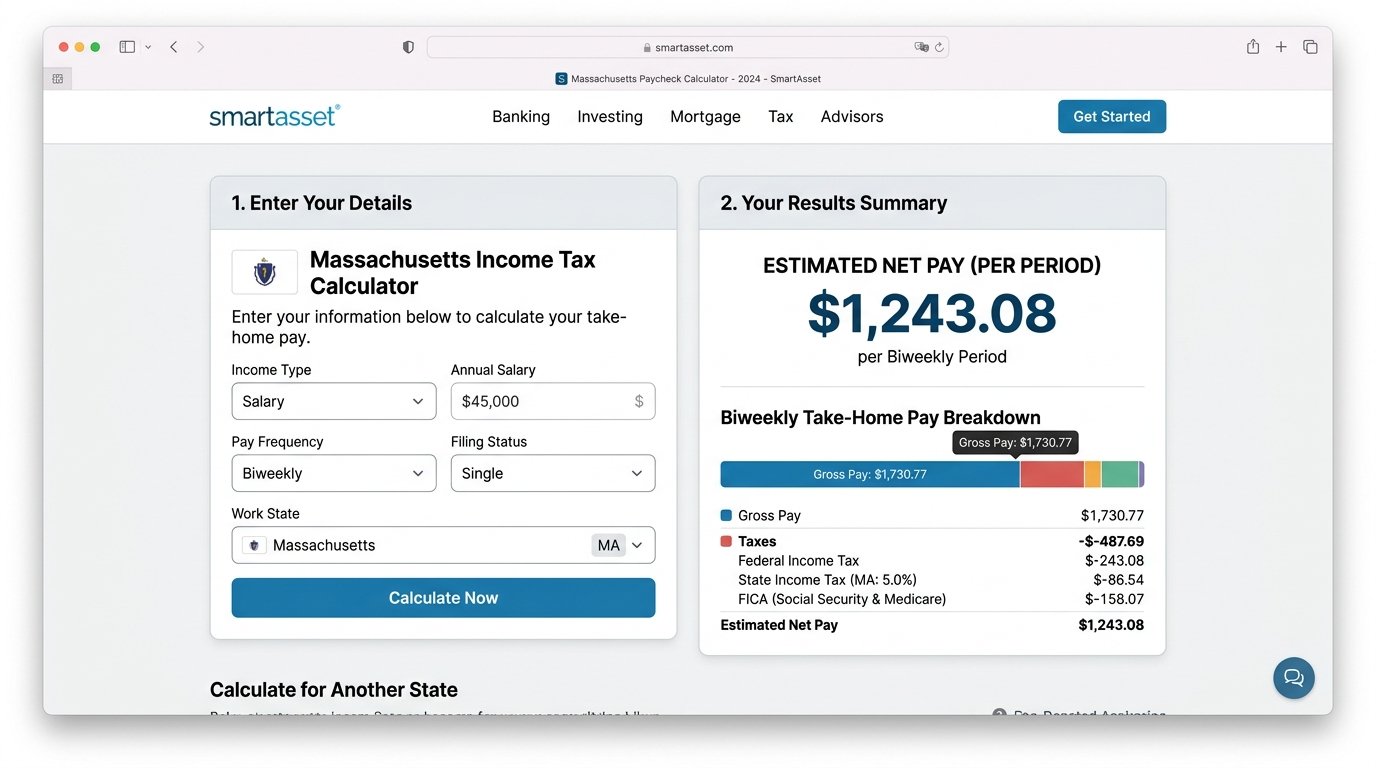
In this guide, we'll explain how a Massachusetts Paycheck Calculator works, the taxes that affect your paycheck, factors that influence your take-home pay, and tips for maximizing your earnings.
What Is a Massachusetts Paycheck Calculator?
A Massachusetts Paycheck Calculator is an online tool that estimates the amount of money you'll receive after all required payroll deductions have been taken from your gross wages.
The calculator generally asks for information such as:
- Annual salary or hourly wage
- Pay frequency
- Filing status
- Federal withholding information
- Retirement contributions
- Health insurance deductions
- Other pre-tax or post-tax deductions
Based on the information you provide, the calculator estimates your net paycheck.
Why Use a Massachusetts Paycheck Calculator?
A paycheck calculator is useful for employees, employers, freelancers, and job seekers alike.
Estimate Your Take-Home Pay
Gross income doesn't reflect the actual amount deposited into your account. A paycheck calculator provides a more realistic estimate.
Create a Better Budget
Knowing your expected paycheck helps you plan for:
- Housing
- Utilities
- Transportation
- Groceries
- Savings
- Loan payments
- Entertainment
Compare Job Offers
When considering multiple employment opportunities, comparing take-home pay instead of gross salary gives a more accurate financial picture.
Plan Tax Withholding
Using a calculator allows you to review whether your tax withholding aligns with your financial goals.
Understanding Payroll Taxes in Massachusetts
Several taxes and deductions reduce your gross earnings before you receive your paycheck.
Federal Income Tax
Federal income tax is withheld based on:
- Filing status
- Income level
- IRS Form W-4
- Tax credits
- Additional withholding elections
Every employee pays federal income tax unless exempt.
Massachusetts State Income Tax
Massachusetts generally applies a flat income tax rate to most taxable income, making payroll calculations simpler than in states with multiple tax brackets.
Your employer withholds state income tax from each paycheck based on your earnings and withholding information.
Social Security Tax
Most employees contribute to Social Security through payroll taxes.
This tax helps fund retirement, disability, and survivor benefits.
There is an annual wage limit, after which Social Security tax is no longer withheld for the remainder of the year.
Medicare Tax
Medicare tax applies to nearly all earned wages.
Unlike Social Security, Medicare tax does not have a wage limit.
Higher-income earners may also be subject to the Additional Medicare Tax.
Gross Pay vs. Net Pay
Understanding these two terms is important.
Gross Pay
Gross pay includes your total earnings before deductions.
It may include:
- Base salary
- Hourly wages
- Overtime
- Bonuses
- Commissions
- Incentive pay
Net Pay
Net pay is your actual take-home income after taxes and deductions.
Net Pay = Gross Earnings − Taxes − Payroll Deductions
Information Required for Accurate Calculations
For the most accurate estimate, enter:
- Gross annual salary
- Hourly wage
- Hours worked
- Overtime
- Pay frequency
- Filing status
- Retirement contributions
- Health insurance premiums
- Flexible Spending Account (FSA) contributions
- Health Savings Account (HSA) contributions
- Other deductions
Providing complete information improves accuracy.
Common Pay Frequencies
Massachusetts employers may pay employees on different schedules.
Common pay periods include:
- Weekly
- Biweekly
- Semi-monthly
- Monthly
Your paycheck amount depends partly on how frequently you're paid.
Hourly Employee Paycheck Example
Suppose you earn:
- Hourly wage: $25
- Hours worked: 40
Weekly gross pay equals:
40 × $25 = $1,000
Federal taxes, Massachusetts state tax, Social Security, Medicare, and other deductions are then withheld to determine your net paycheck.
Salaried Employee Example
Consider an employee earning:
Annual salary: $78,000
Paid biweekly:
$78,000 ÷ 26 = $3,000 gross per paycheck
After taxes and deductions, the employee receives their estimated net pay.
Overtime Pay
Eligible employees generally receive overtime pay at:
- 1.5 times their regular hourly rate
for hours worked beyond 40 in a workweek, unless exempt under applicable labor laws.
Including overtime earnings in your paycheck calculation provides a more accurate estimate.
Bonuses and Supplemental Income
Many employees receive additional compensation such as:
- Performance bonuses
- Holiday bonuses
- Signing bonuses
- Sales commissions
- Profit-sharing
These earnings are generally subject to payroll taxes and federal withholding.
A paycheck calculator helps estimate your after-tax bonus amount.
Pre-Tax Deductions
Pre-tax deductions reduce taxable income before taxes are calculated.
Examples include:
- Traditional 401(k)
- Health insurance
- Dental insurance
- Vision insurance
- Flexible Spending Accounts
- Health Savings Accounts
These deductions may lower your taxable wages and increase your take-home pay.
Post-Tax Deductions
Post-tax deductions are taken after taxes.
Examples include:
- Roth retirement contributions
- Charitable donations
- Wage garnishments
- Union dues
- Certain life insurance premiums
Retirement Contributions
Saving for retirement affects your paycheck.
Common retirement plans include:
- 401(k)
- 403(b)
- IRA
- Roth IRA
Traditional retirement contributions usually reduce taxable income.
Health Insurance Deductions
Many employers provide health benefits.
Employee payroll deductions may cover:
- Medical insurance
- Dental insurance
- Vision insurance
- Family coverage
Health insurance premiums often reduce taxable wages when deducted on a pre-tax basis.
Factors That Affect Your Take-Home Pay
Your paycheck depends on several variables.
These include:
- Annual salary
- Hourly wage
- Overtime
- Bonuses
- Filing status
- W-4 elections
- Retirement contributions
- Insurance deductions
- Tax credits
- Other payroll deductions
Even employees with similar salaries may receive different net pay depending on these factors.
Understanding Your Pay Stub
A typical Massachusetts pay stub includes:
- Gross earnings
- Federal income tax
- Massachusetts state tax
- Social Security
- Medicare
- Retirement deductions
- Insurance premiums
- Year-to-date earnings
- Net pay
Review your pay stub regularly to ensure payroll accuracy.
Advantages of Using a Massachusetts Paycheck Calculator
A paycheck calculator offers many benefits.
These include:
- Fast calculations
- Accurate paycheck estimates
- Better budgeting
- Salary comparison
- Financial planning
- Tax withholding review
- Retirement planning
Most online calculators provide results within seconds.
Who Can Benefit?
Many individuals use paycheck calculators, including:
- Full-time employees
- Part-time workers
- Hourly employees
- Salaried professionals
- HR departments
- Payroll administrators
- Small business owners
- Job seekers
Common Payroll Deductions
Besides taxes, deductions may include:
- Health insurance
- Dental insurance
- Vision insurance
- Retirement plans
- Disability insurance
- Life insurance
- Transit benefits
- Parking benefits
Each deduction affects your final paycheck.
Tips for Maximizing Your Take-Home Pay
While taxes are required by law, you can improve your financial situation through careful planning.
Contribute to Retirement Accounts
Pre-tax retirement contributions may lower taxable income.
Review Your W-4
Update your withholding whenever your financial situation changes.
Use Employer Benefits
Take advantage of health savings accounts and flexible spending accounts if available.
Track Payroll Deductions
Review your pay stub regularly to ensure deductions are accurate.
Mistakes to Avoid
When using a paycheck calculator, avoid:
- Entering incorrect salary
- Choosing the wrong pay frequency
- Forgetting retirement contributions
- Omitting health insurance deductions
- Selecting the wrong filing status
- Ignoring bonuses or overtime
Accurate information produces better estimates.
When Should You Use a Paycheck Calculator?
It's a good idea to calculate your paycheck when:
- Starting a new job
- Receiving a raise
- Working overtime
- Earning bonuses
- Updating your W-4
- Changing benefits
- Planning your monthly budget
- Comparing job offers
Regular calculations help you stay financially prepared.
Final Thoughts
A Massachusetts Paycheck Calculator is a valuable financial tool that helps employees estimate their take-home pay quickly and accurately. By accounting for federal taxes, Massachusetts state income tax, Social Security, Medicare, retirement contributions, health insurance premiums, and other deductions, the calculator provides a realistic estimate of your net earnings.
Whether you're an hourly employee, salaried professional, or employer managing payroll, understanding how your paycheck is calculated allows you to budget effectively, prepare for tax season, and make informed financial decisions. Although actual paychecks may differ slightly depending on employer-specific deductions and payroll policies, a paycheck calculator offers an excellent starting point for planning your finances with confidence.
Frequently Asked Questions (FAQs)
1. What is a Massachusetts Paycheck Calculator?
It is an online tool that estimates your take-home pay after federal taxes, Massachusetts state income tax, Social Security, Medicare, and other deductions.
2. Does Massachusetts have state income tax?
Yes. Massachusetts imposes a state income tax, which employers withhold from employee paychecks according to applicable tax rules.
3. Can I calculate hourly wages?
Yes. Most paycheck calculators support both hourly and salaried employees.
4. Is overtime included?
Yes. Many paycheck calculators allow you to include overtime hours and estimate the additional earnings.
5. Can I include retirement contributions?
Yes. You can usually enter contributions to plans such as a 401(k) or 403(b) to improve the accuracy of the estimate.
6. Do health insurance deductions affect take-home pay?
Yes. Employer-sponsored health insurance premiums often reduce taxable income when deducted before taxes.
7. How accurate are paycheck calculators?
They provide reliable estimates based on the information entered, although actual paychecks may vary slightly due to employer-specific payroll practices.
8. Why is my net pay lower than my salary?
Your paycheck is reduced by taxes and deductions such as federal income tax, Massachusetts state tax, Social Security, Medicare, retirement contributions, and insurance premiums.
9. How often should I use a paycheck calculator?
Use one whenever your salary, benefits, tax withholding, or employment situation changes.
10. Can employers use a Massachusetts Paycheck Calculator?
Yes. Employers and payroll professionals often use paycheck calculators to estimate payroll costs and verify employee paycheck calculations.