Missouri Paycheck Calculator
Calculate your Missouri paycheck instantly using the latest 2026 federal and state tax rates.
Inputs
Pre-Tax Deductions
After-Tax (Post-Tax) Deductions
Bonuses & Overrides
Results Summary
Pay Period Equivalences
| Interval | Net Amount |
|---|---|
| Annual | $0.00 |
| Monthly | $0.00 |
| Semi-Monthly | $0.00 |
| Biweekly | $0.00 |
| Weekly | $0.00 |
| Daily | $0.00 |
| Hourly | $0.00 |
Federal Income Tax
Federal income tax is a progressive tax withheld from your earnings based on IRS tax brackets. Your tax rate increases as your taxable income exceeds predetermined thresholds.
State Income Tax
State income tax is levied by individual state governments. Depending on the state, it can be a flat rate, a progressive scale, or zero.
Social Security
Social Security tax is a federal payroll tax under FICA that funds the retirement and disability benefits program. It is withheld at a flat 6.20% rate up to the annual limit.
Medicare
Medicare tax is withheld at a base rate of 1.45% under FICA to fund hospital insurance benefits. High earners face an additional 0.9% surtax on wages over $200k.
Pre-Tax Deductions
Pre-tax deductions (e.g. standard 401k, HSA, FSA, health premium payments) are taken from gross wages before taxes are calculated, lowering your overall tax bill.
After-Tax Deductions
After-tax deductions (e.g. Roth 401k, life insurance, union dues, charity) occur after tax withholdings are processed and do not reduce taxable wages.
Missouri Paycheck Calculator: Estimate Your Take-Home Pay in Missouri
Understanding how much money you actually take home from each paycheck is an important part of managing your finances. If you work in Missouri, your gross salary is not the same as the amount deposited into your bank account. Federal taxes, Missouri state income tax, Social Security, Medicare, and other deductions can reduce your final paycheck.
A Missouri Paycheck Calculator can help employees estimate their net pay before or after accepting a job. By entering information such as your salary, pay frequency, filing status, and deductions, you can get a clearer idea of how much you may receive each pay period.
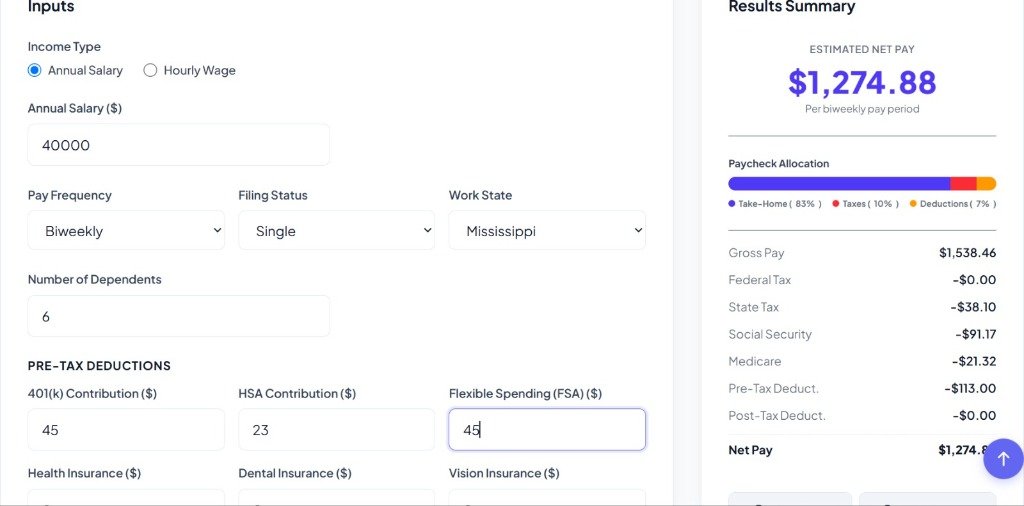
Whether you are paid weekly, biweekly, semi-monthly, or monthly, a paycheck calculator can make it easier to plan your budget and understand your earnings.
What Is a Missouri Paycheck Calculator?
A Missouri Paycheck Calculator is an online tool designed to estimate an employee's take-home pay after taxes and other payroll deductions. The calculator generally starts with your gross income and subtracts estimated federal, state, and payroll taxes.
For example, if your annual salary is $60,000, you will not normally receive $60,000 directly in your bank account. Your employer will withhold applicable taxes and other deductions from your paychecks throughout the year.
A Missouri paycheck calculator can estimate:
- Gross pay
- Federal income tax
- Missouri state income tax
- Social Security tax
- Medicare tax
- Retirement contributions
- Health insurance deductions
- Other payroll deductions
- Estimated net or take-home pay
The exact amount you receive can vary depending on your personal circumstances, tax elections, benefits, deductions, and other factors.
Why Use a Missouri Paycheck Calculator?
Knowing your expected take-home pay can help you make better financial decisions. Salary offers are usually presented as gross annual compensation, but your monthly budget depends on your net income.
A Missouri paycheck calculator can be useful when:
- Comparing job offers
- Planning a household budget
- Estimating monthly income
- Determining affordable rent or mortgage payments
- Planning retirement contributions
- Reviewing payroll deductions
- Preparing for a new job
- Understanding the effect of a raise
- Comparing different pay frequencies
- Estimating overtime income
For example, two jobs may offer similar annual salaries but have different benefits and deductions. Calculating estimated net pay can help you understand the difference.
Missouri Income Tax
Missouri has a state individual income tax system. The amount of Missouri income tax withheld from your paycheck depends on your taxable income and applicable deductions or exemptions.
Your paycheck may therefore be affected by both federal and Missouri income taxes.
When using a Missouri Paycheck Calculator, you may need to provide information such as your filing status, income, and other applicable details to estimate your state tax withholding.
Tax laws and rates can change, so paycheck estimates should be treated as estimates rather than guarantees of your final tax liability.
Federal Income Tax in Missouri
Missouri employees are generally subject to federal income tax withholding in addition to state income tax.
Federal income tax is based on factors including:
- Total taxable wages
- Filing status
- Form W-4 elections
- Dependents
- Additional withholding
- Certain deductions and credits
Your employer generally uses the information you provide on Form W-4 to determine how much federal income tax to withhold from your paycheck.
Because individual circumstances differ, two employees earning the same salary can have different federal tax withholding amounts.
Social Security and Medicare Taxes
Most employees in Missouri also have Social Security and Medicare taxes withheld from their wages.
These taxes are commonly referred to as FICA taxes, which stands for Federal Insurance Contributions Act.
Social Security tax helps fund Social Security programs, while Medicare tax helps fund Medicare.
For many employees, these payroll taxes are automatically withheld from each paycheck. A Missouri paycheck calculator generally includes them when estimating take-home pay.
The amount of Social Security tax may be affected by the annual Social Security wage base, while Medicare taxation follows its own rules.
Gross Pay vs. Net Pay
One of the most important concepts to understand when using a Missouri paycheck calculator is the difference between gross pay and net pay.
Gross Pay
Gross pay is the amount you earn before taxes and deductions.
For a salaried employee, this could be the annual salary divided by the number of pay periods.
For example, an employee earning $60,000 per year and receiving 26 biweekly paychecks would have approximately:
$60,000 ÷ 26 = $2,307.69 gross pay per paycheck
This is before applicable taxes and deductions.
Net Pay
Net pay is the amount remaining after taxes and other deductions have been taken out.
This is commonly called your take-home pay because it represents the money you actually receive.
Your net paycheck can be significantly lower than your gross paycheck because of federal taxes, state taxes, payroll taxes, insurance, retirement contributions, and other deductions.
Missouri Paycheck Calculator and Pay Frequency
Your pay frequency determines how often you receive your paycheck. Common schedules include:
Weekly Pay
Weekly employees receive 52 paychecks per year.
Biweekly Pay
Biweekly employees receive 26 paychecks per year. Some months will have two paychecks, while two months of the year will typically have three paychecks.
Semi-Monthly Pay
Semi-monthly employees usually receive 24 paychecks per year, often on specific dates such as the 15th and last day of the month.
Monthly Pay
Monthly employees receive 12 paychecks per year.
Your annual salary generally remains the same regardless of pay frequency, but the amount of each individual paycheck changes.
How to Calculate a Missouri Paycheck
You can estimate your paycheck by following a few basic steps.
Step 1: Determine Your Gross Pay
Start with your annual salary or hourly earnings.
If you are paid hourly, multiply your hourly rate by the number of hours worked.
For example:
$25 × 40 hours = $1,000 gross weekly pay
If you work overtime, include applicable overtime wages.
Step 2: Determine Federal Tax Withholding
Federal income tax withholding is calculated based on your income and tax withholding information.
Your W-4 elections can significantly affect the amount withheld.
Step 3: Calculate Missouri State Tax
Missouri state income tax may be withheld from your wages depending on your taxable income and circumstances.
A paycheck calculator can provide an estimated state tax amount based on the information entered.
Step 4: Include Social Security and Medicare
Payroll taxes may also be deducted from your paycheck.
These generally include Social Security and Medicare taxes.
Step 5: Add Other Deductions
Your paycheck could include additional deductions such as:
- Health insurance
- Dental insurance
- Vision insurance
- 401(k) contributions
- HSA contributions
- FSA contributions
- Union dues
- Other voluntary deductions
After these amounts are considered, you can estimate your final take-home pay.
Example of a Missouri Paycheck Estimate
Suppose an employee earns $60,000 per year and is paid biweekly.
The gross paycheck would be approximately:
$60,000 ÷ 26 = $2,307.69
However, the employee will not necessarily receive $2,307.69 in their bank account.
The paycheck may be reduced by:
- Federal income tax
- Missouri income tax
- Social Security
- Medicare
- Retirement contributions
- Insurance premiums
- Other deductions
The final amount deposited into the employee's account is the net paycheck.
The exact net amount depends on the employee's tax situation and deductions, so a calculator should be used with accurate personal and payroll information for a more useful estimate.
Factors That Can Change Your Missouri Paycheck
Several factors can affect your take-home pay.
Salary
Higher earnings generally result in higher tax withholding, although the relationship is not simply a fixed percentage.
Filing Status
Your federal tax filing status can influence federal withholding.
Dependents
Dependents and related tax information can affect your federal tax situation.
Pay Frequency
Weekly, biweekly, semi-monthly, and monthly schedules result in different paycheck amounts.
Retirement Contributions
Contributing to an employer-sponsored retirement plan can reduce your current take-home pay while helping you save for retirement.
Health Insurance
Employee-paid health insurance premiums can reduce your paycheck.
Overtime
Overtime can increase gross earnings and may also increase withholding.
Bonuses
Bonuses and other supplemental wages can be treated differently for payroll withholding purposes.
Missouri Paycheck Calculator for Hourly Employees
A Missouri paycheck calculator can also be helpful for hourly workers.
Suppose you earn $20 per hour and work 40 hours per week:
$20 × 40 = $800 gross weekly pay
If you work overtime, your gross pay may increase.
For example, if you work additional hours at an applicable overtime rate, those earnings should be added to your regular wages before estimating deductions.
Hourly employees should also consider fluctuating schedules, unpaid time off, overtime, bonuses, and commissions when estimating annual income.
Missouri Paycheck Calculator for Salaried Employees
Salaried employees generally receive a predetermined annual salary.
For example, someone earning $72,000 annually may receive:
- $6,000 monthly before deductions
- $3,000 semi-monthly before deductions
- About $2,769.23 biweekly before deductions
- About $1,384.62 weekly before deductions
These figures represent gross pay, not take-home pay.
Taxes and other deductions must still be considered to estimate the actual amount deposited into the employee's account.
Pre-Tax and After-Tax Deductions
Another important feature of paycheck calculations is understanding the difference between pre-tax and after-tax deductions.
Some employee benefits may be deducted before certain taxes are calculated, while others may be deducted after taxes.
Examples can include certain:
- Retirement contributions
- Health insurance premiums
- Flexible spending contributions
- Health savings account contributions
The tax treatment depends on the specific benefit and applicable rules.
This is why simply subtracting a flat percentage from your salary may not produce an accurate estimate of your take-home pay.
How a Missouri Paycheck Calculator Helps With Budgeting
Knowing your estimated net income can make personal budgeting easier.
For example, you can use your estimated monthly take-home pay to plan for:
- Housing
- Utilities
- Groceries
- Transportation
- Insurance
- Debt payments
- Savings
- Retirement
- Entertainment
- Emergency funds
Instead of budgeting based on your gross salary, using estimated net pay can give you a more realistic picture of the money available for expenses.
Missouri Paycheck Calculator vs. Tax Calculator
Although these tools are related, they are not exactly the same.
A paycheck calculator focuses primarily on estimating income received from employment after payroll deductions.
A tax calculator may focus on estimating total annual tax liability or tax refunds based on broader financial information.
A paycheck calculator is particularly useful when you want to answer questions such as:
“If I earn $70,000 in Missouri, how much might I take home each month?”
A tax calculator may instead help answer:
“How much federal and state tax might I owe for the year?”
Both tools can be useful, but they serve different purposes.
Tips for Getting a More Accurate Estimate
For a better Missouri paycheck estimate, enter as much accurate information as possible.
Consider including:
- Your annual salary or hourly wage
- Pay frequency
- Filing status
- W-4 information
- Dependents
- Retirement contributions
- Health insurance premiums
- Other payroll deductions
- Overtime income
- Bonuses or commissions
Remember that calculator results are estimates. Your actual paycheck depends on your employer's payroll system, withholding elections, benefits, and current tax rules.
Frequently Asked Questions About Missouri Paycheck Calculator
1. What is a Missouri Paycheck Calculator?
A Missouri Paycheck Calculator is an online tool that estimates your take-home pay after considering federal taxes, Missouri state taxes, Social Security, Medicare, and other deductions.
2. Does Missouri have a state income tax?
Yes. Missouri imposes individual income tax, and eligible employees may have Missouri income tax withheld from their paychecks.
3. Does a paycheck calculator show net pay?
Yes. The primary purpose of a paycheck calculator is to estimate net or take-home pay after applicable deductions.
4. Can I use the calculator for hourly wages?
Yes. You can generally use a Missouri paycheck calculator for hourly employees by entering your hourly wage, working hours, pay frequency, and overtime information where applicable.
5. Can salaried employees use a Missouri paycheck calculator?
Yes. Salaried employees can enter their annual salary and other relevant information to estimate their paycheck.
6. How often are Missouri employees paid?
Employers may use different payroll schedules, including weekly, biweekly, semi-monthly, or monthly schedules. The exact schedule depends on the employer.
7. Why is my paycheck lower than my salary divided by the number of paychecks?
Salary divided by the number of pay periods gives you an approximate gross paycheck. Your actual take-home pay is lower because taxes and other deductions are withheld.
8. Does a Missouri paycheck calculator include Social Security?
Most paycheck calculators include Social Security and Medicare taxes when estimating employee payroll deductions.
9. Can health insurance affect my paycheck?
Yes. Employee-paid health insurance premiums can reduce the amount you receive in your paycheck, depending on the plan and tax treatment.
10. Can a 401(k) contribution reduce my take-home pay?
Yes. Money contributed to a traditional employer-sponsored retirement plan is generally deducted from your paycheck, although its tax treatment can reduce taxable wages for certain taxes.
11. Are paycheck calculator results exact?
No. Online paycheck calculators provide estimates. Your actual paycheck can differ because of employer payroll practices, tax elections, benefits, deductions, and changes in tax rules.
12. Can I use a Missouri paycheck calculator before accepting a job?
Yes. It can be useful when comparing job offers because it helps you estimate the difference between gross compensation and potential take-home pay.
Final Thoughts
A Missouri Paycheck Calculator is a useful financial planning tool for employees who want to understand their expected take-home pay. Your gross salary is only the starting point. Federal income tax, Missouri income tax, Social Security, Medicare, retirement contributions, insurance premiums, and other deductions can all affect the amount that reaches your bank account.
Whether you are starting a new job, negotiating a salary, planning a household budget, or simply trying to understand your paycheck, estimating your net income can help you make more informed financial decisions.
For the most useful estimate, enter accurate information about your salary, pay frequency, filing status, deductions, and benefits. Because tax laws and individual circumstances can change, use calculator results as estimates and consult official tax or payroll resources when you need precise tax information.